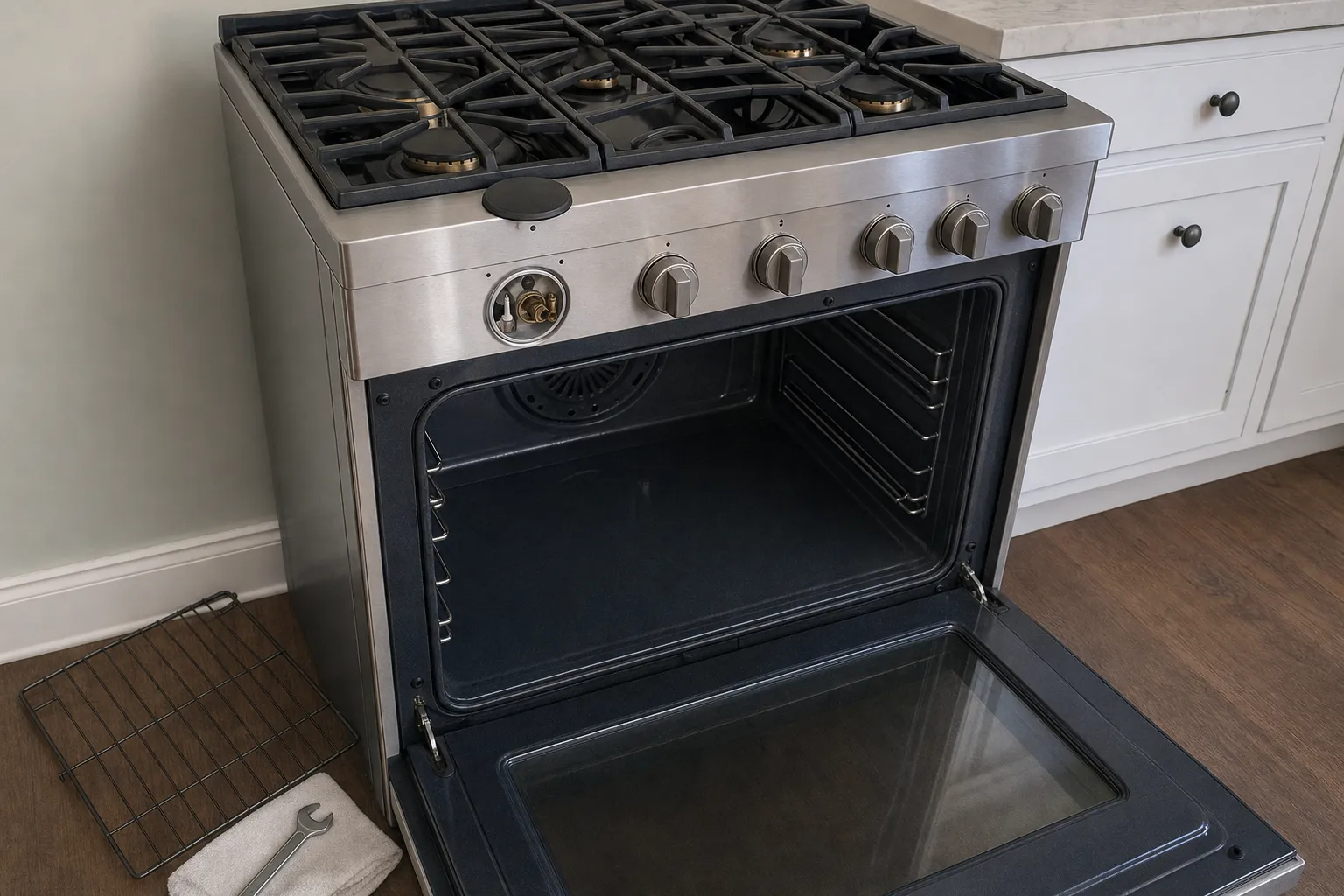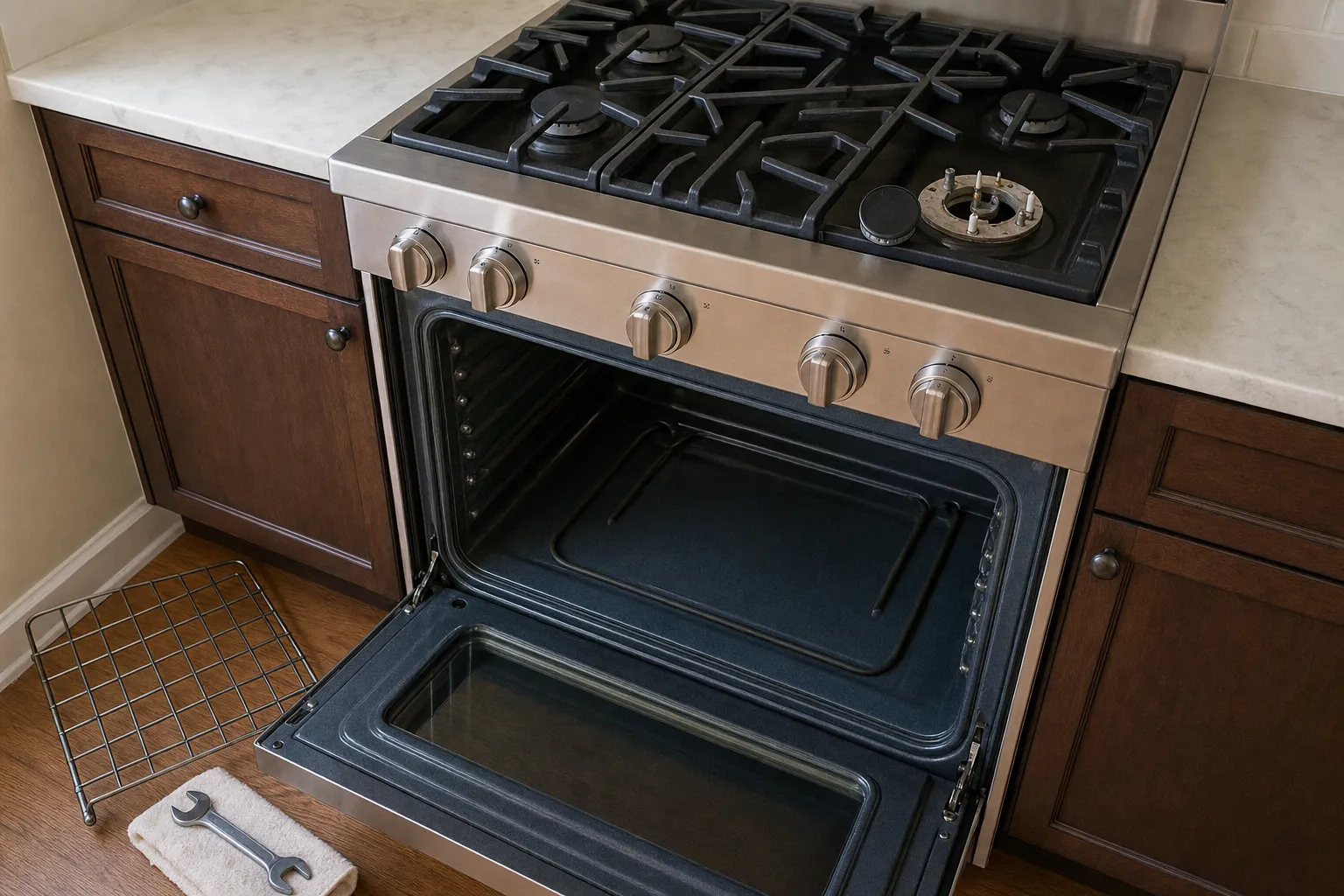
A Viking sealed burner that clicks endlessly without lighting is the single most common range call we take in Kirkland, and it is also the one most often fixed with the wrong part. The clicking means the spark module is doing its job. The electrode is producing a spark. Something is stopping that spark from meeting a proper mixture of gas and air at the right place, and most often it is a millimetre of geometry rather than an electronic failure.
What the clicking actually is
On a Viking sealed-burner range, one spark module fires every electrode on the cooktop at the same time. Turn on the right-front burner and you will hear the left-rear clicking too. That is designed behaviour, not a fault, and it catches a lot of people out — the fact that all four are sparking tells you the module has power and is firing.
Ignition needs three things arriving together: a spark, gas flowing from the ports nearest the electrode, and enough air mixed in for that gas to burn. The spark you can hear. The gas you can usually smell. So a burner that clicks without lighting is almost always a delivery or geometry problem at the burner head, and that is very good news, because those are cheap to fix.
Start with the burner cap — it is the usual answer
Take the cap off and look at how it sits. On Viking sealed burners the cap locates on the burner base with a small amount of play, and if it goes back rotated, tilted or seated on a crumb of debris, the ports near the electrode end up pointing away from the spark. The burner then lights late, lights with a thump, or does not light at all.
Three things to check in order, with the range cold:
- Seating. Lift the cap and set it back down deliberately. It should drop flat, with no rock in it. A cap that rocks is a cap that will not light.
- Wetness. After a boil-over or a wipe-down, water sits in the burner base and under the cap. A damp electrode will spark to the nearest wet metal instead of igniting gas. Dry everything and leave it an hour.
- Blocked ports. Hold the cap up to the light and look at the slots around its edge. Carbon, sugar from a spill, or a grain of rice will close one, and the ones by the electrode are the ones that matter.
Clean the cap in warm water with a soft brush — never a wire brush, which burrs the port edges and makes the problem permanent — dry it fully, and reseat it. This resolves a large share of the calls we would otherwise be booked for.
When one burner is dead and the rest are fine
If everything else lights normally and only one refuses, the fault is local to that burner. After the cap, the next suspects are the electrode and the orifice.
The electrode is a ceramic-insulated pin that should sit a couple of millimetres from the burner head. If it has been knocked in cleaning or during a previous repair, the gap goes wrong and the spark jumps to the wrong place. A cracked ceramic does the same thing — the spark leaks to the burner base and you can often see it arcing at the base of the pin in a darkened kitchen.
The orifice is the brass jet under the burner. It sets how much gas reaches the head, and it is sized for the fuel the range was set up for. On older Kirkland homes where a range has been moved, converted from propane, or fitted during a kitchen remodel, an orifice that does not match the supply produces exactly this symptom: a burner that sparks, hesitates and finally lights with a bang, or one that will not catch at all.
When every burner clicks and none light
That changes the diagnosis. A cooktop where nothing lights, but everything sparks, points upstream at gas delivery rather than at any one burner.
We start at the regulator and read manifold pressure against the rating plate on the range. Low pressure starves every burner equally, and it usually comes from a regulator that has drifted, a supply line that was never sized for a professional range, or a shutoff valve that is not fully open after work elsewhere in the house. This is the fault we find most often behind whole-cooktop complaints in homes where the range was installed during a remodel rather than with the house.
The other whole-cooktop cause is the spark module itself, which is worth naming because it is what gets replaced by guesswork. A genuinely failed module usually does not click at all, or clicks on some channels and not others. A module that fires every electrode cleanly is doing its job — replacing it will not change anything, and it is one of the more expensive parts on the cooktop.
Continuous clicking after the burner is already lit
A slightly different symptom, and one worth separating out. If a burner lights normally and then keeps clicking, the module is not seeing a flame where it expects one. The usual cause is a wet or dirty electrode, or a cap that is seated just far enough out for the flame to sit away from the sensing point. The same cleaning routine applies, and if the clicking persists on a clean, correctly seated burner, the electrode or its lead is breaking down and should be replaced rather than lived with.
What we do on the call
A diagnostic on this symptom takes about half an hour. We pull and inspect every cap and burner head, check electrode gap and ceramic condition, read manifold pressure under load with two burners running, verify the orifice sizes against the rating plate, and test the spark module’s output per channel rather than as a set. Anything opened on the gas train gets leak-tested before we leave.
Most of the time you get a cleaned and correctly seated burner, sometimes a new electrode or orifice, and an explanation of what caused it. Occasionally it is the regulator. It is very rarely the module — and if it is, you will see the reading that says so.
Asked after reading this
Should I keep turning the knob while it clicks without lighting?
No. Turn the knob off, open a window and wait until you can no longer smell gas before trying again, because every unlit attempt lets gas into the room. If the burner has not caught after two tries, leave it off and work through the cap and electrode checks in this note instead.
Is it a fault that every burner clicks when I turn just one knob?
No. A single spark module drives all the electrodes on these ranges together, so every position clicks while you light one, and only the burner receiving gas catches. It becomes a fault when one position stays silent while the rest spark, or when the clicking carries on after a steady flame is showing.
Can I light the burner with a match until it is repaired?
Usually, yes. With the knob turned to light, a long match or a gas lighter held at the ports will light a sealed burner. Keep your hand clear, never leave a knob open while you look for a flame, and if you smell gas with every knob off, leave the house and call the gas utility.