To adjust oven temperature, measure it before you change anything. Set an oven thermometer on a middle rack, heat to 350°F, take a reading every ten minutes for half an hour once preheat finishes, and average them. If that average sits steadily above or below the dial, enter the difference as an offset, either through the calibration setting of an electronic control or with the small screw some mechanical thermostats keep behind the knob. If the oven is off by a wide margin, or gives a different answer on every run, no offset will help: a sensor, element, thermostat or igniter is wearing out. The method is the same for a Viking range in a Juanita remodel and a wall oven in a newer Totem Lake kitchen, and all it costs is a thermometer.
Run a fair test first
The display only tells you what the control believes. A thermometer tells you what the food actually experiences. Use a dial or probe thermometer rated for oven heat, and set up the test the same way every time:
- Clear the cavity except for one rack in a middle position, and stand or clip the thermometer near its center.
- Choose plain bake rather than convection and set 350°F.
- Wait about 20 minutes after the oven signals that it is preheated, because the walls and racks are still soaking up heat before then.
- Read through the window if you can, or open the door only for a moment, every 10 minutes across 30 minutes.
- Average the readings and write the figure down with the date and the setting.
Every oven cycles. The burner or element switches on below the target and off above it, so two single readings 20 degrees apart are perfectly normal. Only the average counts.
What your average is telling you
| Average against the dial | What to do |
|---|---|
| Close to the setting on every run | Leave it alone |
| Off by the same amount each run, about 15°F or more | Enter that amount as an offset |
| Far off, or a different answer each run | Stop adjusting and look for a failing part |
Repeat the test on a second day before acting. One strange result can come from a door left ajar or a cold pan sitting on the rack.
Making the adjustment
Ovens with an electronic control
Many digital ovens hide a temperature offset inside a settings or options menu. It shifts the control’s target without touching any hardware. The key sequence differs between models, so follow the Use & Care manual for your oven instead of experimenting, since a wrong press can change other settings. Enter the measured gap in the direction that corrects it: an oven averaging 330°F at a 350°F setting needs its target raised by 20. Then repeat the whole test to confirm.
On 5 and 7 Series electric wall ovens, SAb is the Sabbath mode setting. Make sure the oven is back in ordinary bake before you test, so you are measuring the mode you actually cook in.
Ovens with a knob-driven thermostat
Mechanical controls have no menu. On some, the knob pulls straight off and exposes a slotted screw in the thermostat shaft, or a ring on the back of the knob, that slides the scale. A small turn can move the oven a lot, and the direction differs between thermostats, so check the manual, turn in small steps and retest after each one. If there is no screw, or the manual never mentions one, the thermostat is not meant to be set at home.
Viking details that change the test
- Setting range. Electric wall ovens in the 5 and 7 Series run from 200°F to 550°F, so 350°F sits comfortably mid-band. If yours reads true at 350°F but badly near the top of the dial, tell the technician, because that points to a sensor rather than a simple offset.
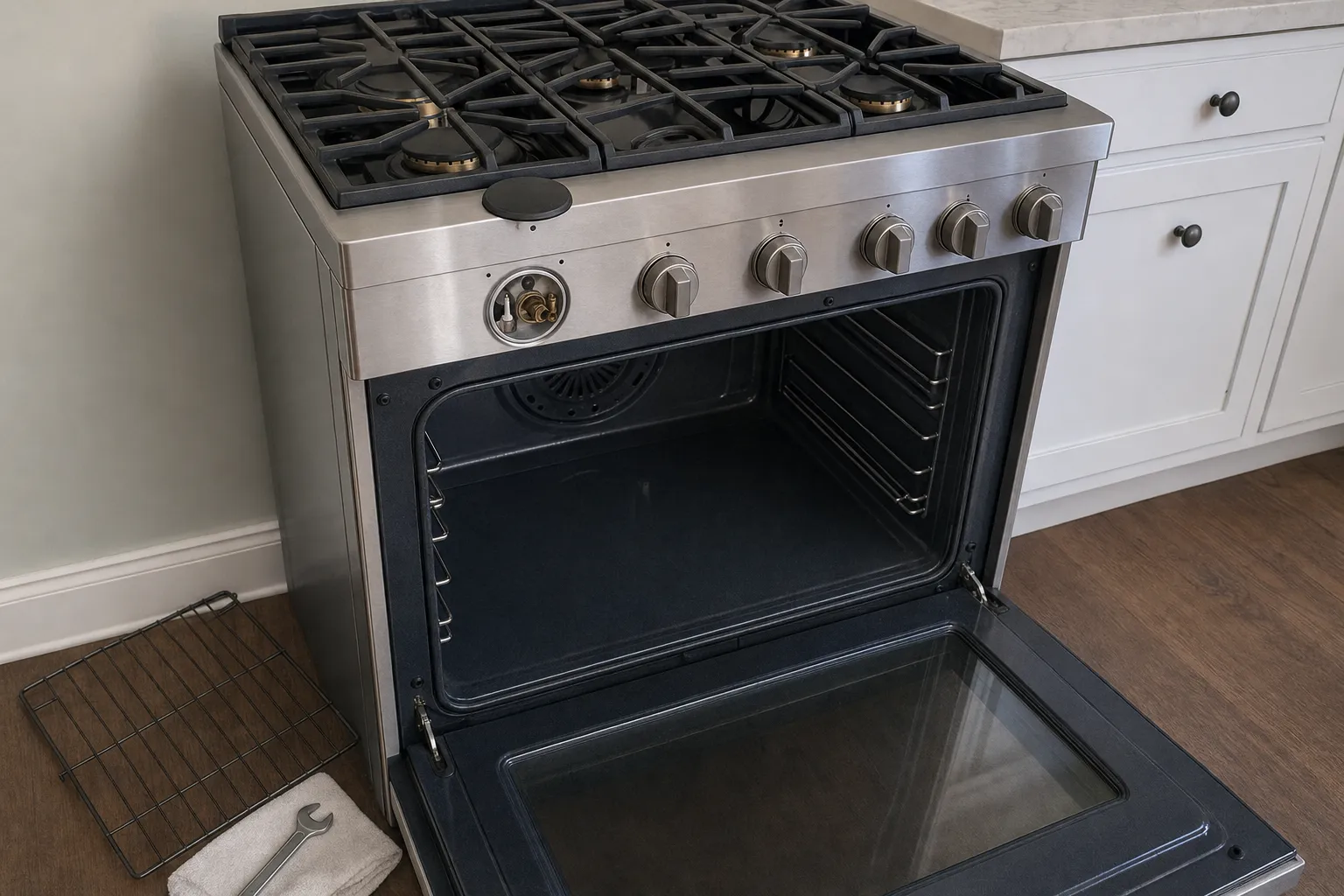
- Gas range ovens. A 5 Series gas range oven bakes with a single 30,000 BTU U-shaped burner, broils with a Gourmet-Glo infrared broiler, lights both through SureSpark ignition, and offers six rack positions. Test on a middle position, well away from the broiler.
- Gas versus electric. Viking describes its gas ovens as best for broiling and one-rack baking, and its electric ovens, with Vari-Speed Dual Flow convection, as the better choice for several racks at once. If two trays in a gas oven brown differently, that is the design at work, not a calibration fault.
When drift is a part, not a setting
An offset corrects a steady error. It cannot rescue a component that is failing, and these are the usual culprits:
- Temperature sensor. The probe on the back wall changes resistance as it heats. Once it ages or its wiring gets baked, the control misreads the cavity and the error grows or jumps around.
- Bake element. A blistered or cracked element may still glow in patches but heat slowly, so the oven creeps toward temperature and food browns on top while staying pale underneath.
- Mechanical thermostat. The sensing bulb inside the cavity can lose its charge or get kinked, leaving the oven far off or swinging widely.
- Igniter on a gas oven. The burner must relight every time the control calls for heat. A weak igniter that is slow to let gas flow, or ignition that struggles to catch, lets the cavity sag well under the target between cycles. A gas smell, clicking with no flame, or a flame that lights and dies means switch the oven off and stop trying.
Getting it checked in Kirkland
If your readings point to a failing part rather than a steady offset, Viking Repair Kirkland comes out to homes in Moss Bay, Juanita, Totem Lake and Bridle Trails. A visit costs $89, which covers getting here plus the complete diagnosis; should you go ahead, the repair price drops by that same $89. Beyond that, the bill depends on what failed: a new heating element, thermostat or igniter is usually the more modest job, while a replacement touch panel or control board costs noticeably more. The technician confirms the exact figure after tracking down the cause. You can see what goes into an oven element or thermostat repair or a range or oven control board, or read more about our Viking oven repair service.
Have your written test results ready when you call (425) 629-0033. The setting, the average and the dates often shorten the diagnosis considerably.
Asked after reading this
How far off can an oven be before it needs adjusting?
If the average of several readings lands within roughly 10°F of the dial, leave it alone, because every oven cycles above and below its set point. A steady gap of about 15°F or more on two separate days is worth an offset, while a large or shifting gap points to a worn part instead.
Can a self-clean cycle throw off my Viking oven's temperature?
It can, because self-clean is the hottest job the oven does: Viking ovens reach up to 750°F to turn soil to ash, usually for 3 to 3½ hours plus a 30-minute cool-down. If baking changed right after a clean, retest. The VSOF7301 and the upper oven of the VDOF7301 have no self-clean.
Why does my gas oven still bake cold after I enter an offset?
Usually the fault is a slow relight rather than a steady error. If the burner takes too long to catch each time the control asks for heat, the cavity sinks well under the set point between cycles, and no offset can make up for that lost time. It needs a diagnosis, not another adjustment.
One cavity of my double oven will not heat at all. Is that a calibration problem?
No, an oven that makes no heat has a failed part, not a setting that drifted. A dead element, igniter, sensor circuit or control output on that side is the usual cause, and recalibrating cannot revive it. Note whether the light, fan and display still work there and mention it when you call.
Is it safe to turn the thermostat screw behind the knob myself?
Only when your manual says that screw is meant for owners. Pull the knob with the oven off and cold, move the screw slightly, then rerun the full thermometer test before touching it again. Never remove panels or loosen fittings on a gas oven to chase a few degrees; leave that to a technician.